Cricket Sport Betting Explained: Strategy Guide and Full Payout Calculations
How does cricket spread betting work?
If you want to understand cricket spread betting, here are the 7 things to get straight before you place one:
A spread is a range, not a single number. You never bet on an exact outcome, you bet on whether the real result lands above or below the firm's quoted range.
Payout follows one formula everywhere: stake multiplied by the difference between your buy or sell price and the actual final result.
Spread betting has no maximum loss built in, which makes it structurally different and genuinely riskier than a fixed stake you agree upfront.
Team total runs, match aggregate runs, total wickets, and individual player performance are the four spread markets that show up most often in cricket.
Session spreads in Test cricket move fast, since a single boundary-heavy over can shift the runs spread by several points in a couple of minutes.
PlayZeet does not offer spreads at all. Every cricket prediction on PlayZeet uses a fixed stake agreed directly with another user, so your maximum loss is always known before you confirm.
India's Test tour of Sri Lanka, Pakistan's tour of England, and Bangladesh's historic first tour of Australia in 23 years are all live in August 2026 and worth studying before staking anything.
Cricket spread betting: key terms at a glance
Spread: the quoted range for a measurable outcome, such as 260 to 270 runs. Buy price: the top of the range, staked on if you expect a higher result. Sell price: the bottom of the range, staked on if you expect a lower result. Stake per point: the amount you win or lose for every single unit the result moves away from your price. Liability: your total possible loss, which is uncapped in spread betting and scales with how far the market moves.
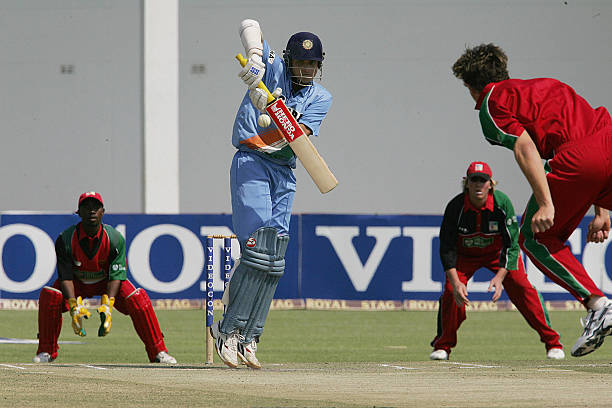
A single over changed everything. Chasing 280, a team needed six an over with four wickets in hand, comfortably placed against any fixed line a bookmaker might have quoted.
Then an 19-run over happened, three boundaries and a dropped catch that should have been a wicket, and the runs spread that had sat calmly all afternoon jumped hard in one direction. Anyone holding a sell position on team runs at that exact moment watched their liability grow in real time, over a single six-ball passage of play.
That volatility is exactly what makes cricket spread betting both compelling and genuinely dangerous for anyone who has not sat down and worked through the payout mechanics first.
This guide breaks down precisely how spread betting payouts are calculated, the markets that show up most often, the liability risk almost nobody explains clearly enough, practical points for reading a spread before you touch it, and exactly how PlayZeet's stake-based model handles cricket completely differently, with a full step-by-step walkthrough.
If cricket is your first sport to bet on at all, essential answers for new bettors is worth reading alongside this guide before you place anything.
What Is Cricket Spread Betting?

Cricket spread betting is a wagering format where a firm quotes a range, called the spread, for a measurable outcome like a team's total runs, and you bet on whether the real result finishes above or below that range instead of on a fixed price.
It began in UK financial markets in the 1980s as a way to speculate on the direction of a stock or index without owning the underlying asset, and cricket, along with several other sports, adopted the same mechanic decades later.
What Are Buy and Sell Prices in Spread Betting?
The buy price and sell price are the two numbers that make up a cricket spread, set close together around the firm's own prediction for the outcome.
If a firm quotes England's first innings total runs at 305 to 315, selling at 305 means you believe the actual total finishes below that number, and buying at 315 means you believe it finishes above.
There is no single correct price the way there is with a fixed stake, only the direction you believe the real outcome will move relative to the quoted range.
Why Does Spread Betting Have No Maximum Win or Loss?
Spread betting has no maximum win or loss because your payout is calculated by multiplying your stake per point by the actual distance the market moves, and that distance has no built-in ceiling or floor.
A team collapsing from 250 to 140 all out turns a small sell position into a very large win, and the same collapse turns a buy position into a very large loss, both scaling with exactly how far the result travels from the quoted spread.
How Is a Cricket Spread Betting Payout Calculated?

A cricket spread betting payout is calculated by multiplying your stake per point by the difference between your buy or sell price and the actual final result. Every market, whether it is team runs, match aggregate runs, or player wickets, reduces to one of the two formulas below.
What Is the Cricket Spread Betting Payout Formula?
Profit or loss = Stake per point x (Actual result minus your buy price), if you bought.
Profit or loss = Stake per point x (Your sell price minus the actual result), if you sold.
Your stake is expressed as an amount per point rather than as a single fixed amount, which is exactly why the total swings with the final number rather than staying fixed.
How Do You Calculate a Team Runs Spread Payout?
You calculate a team runs spread payout by multiplying your stake per point by the gap between your buy or sell price and the team's actual final total. Suppose a firm quotes a team's total runs at 260 to 270, and you stake 50 naira per run on the buy side at 270, believing the team scores more.

If the team finishes on 310, your profit is 50 multiplied by (310 minus 270), which is 50 times 40, for a total profit of 2,000 naira. If instead the team collapses to 190, your loss is 50 multiplied by (270 minus 190), which is 50 times 80, for a total loss of 4,000 naira, a bigger number than your original intended risk because the market moved further than you expected.
How Do You Calculate a Player Performance Spread Payout?
You calculate a player performance spread payout the same way, multiplying your stake per point by the gap between your price and the player's actual final number. A bowler's total match wickets might be quoted at 3 to 4.
Selling at 3 for 20 naira per wicket means you believe the bowler takes fewer than three wickets across the match. If the bowler finishes with a single wicket, your profit is 20 multiplied by (3 minus 1), which is 40 naira.
If instead the bowler has a career day and takes seven wickets, your loss is 20 multiplied by (7 minus 3), which is 80 naira, four times your intended stake purely because the outcome moved further from the spread than anticipated.
In the United Kingdom, sports spread betting has traditionally sat under the Financial Conduct Authority rather than the Gambling Commission alone, because a spread bet is structured as a legally enforceable financial contract under the Financial Services and Markets Act 2000. Spreadex, one of the sector's established operators, is authorised and regulated by the FCA for spread betting activity while separately holding a Gambling Commission licence for its fixed-odds products. This dual structure is precisely why spread betting firms are required to hold client funds in segregated accounts and disclose liability risk clearly before you can open an account.
What Are the Most Common Cricket Spread Betting Markets?

The five most common cricket spread betting markets are team total runs, match aggregate runs, total wickets, player performance, and session runs. Learning these properly, and keeping a full glossary of betting terms on hand for anything unfamiliar, is worth doing before staking real money on any of them.
1. What Is the Team Total Runs Market?
Team total runs is the most common spread market in both Test and limited-overs cricket, and it predicts a team's total innings score against the firm's quoted range. This is the market most exposed to a single dramatic over swinging the spread hard in either direction.
2. What Is the Match Aggregate Runs Market?
Match aggregate runs predicts the combined total from both sides across a full match rather than one team's total alone. It moves more slowly than a single-team spread because it smooths out one team's collapse against the other team's form, but it still carries the same uncapped liability structure.
3. What Is the Total Wickets Market?
Total wickets predicts how many wickets fall across a defined period of a match, whether that is a single innings or the whole game. This market is highly sensitive to pitch and weather conditions, since a seaming, overcast morning in England produces a completely different wicket count to a flat, dry pitch in the subcontinent.
4. What Are Player Performance Spread Markets?
Player performance spreads predict an individual's batting runs or bowling wickets for a named player in a single match. These markets carry higher variance than team markets because a single player's form can swing wildly between matches, which is exactly what makes them attractive to experienced spread bettors and dangerous for beginners chasing a big number.
5. What Is a Session Runs Spread in Test Cricket?
A session runs spread predicts how many runs are scored within a single defined session, typically the two hour blocks that structure a Test match day. Session spreads move the fastest of any cricket market because the sample size is small, which means a couple of boundary-heavy overs can shift the entire spread within minutes.
Is Cricket Spread Betting Risky?

Yes, cricket spread betting is riskier than fixed-stake betting because losses are not capped and can exceed your original stake by several multiples. Every spread betting firm discloses this, usually in bold text during account opening, since the payout scales with how far the market moves rather than stopping at a fixed number you agreed to risk.
The liability trap most beginners miss
A team collapsing from 250 for 2 to 190 all out is not a rare event in cricket, it happens across formats regularly. If you are holding a buy position on team runs when that collapse happens, your loss is calculated on the full distance the market moved, not on the amount you originally intended to risk.
Before placing any spread bet, calculate your worst realistic case scenario using the payout formula above, not just your best case.
How Much Should You Stake Per Point as a Beginner?
A beginner should size their stake per point by dividing their maximum acceptable overall loss by a realistic worst-case swing for the specific market, not by the average swing.
A team runs spread can realistically move 60 to 80 runs in either direction across a full innings, so a beginner risking 4,000 naira overall should be staking closer to 50 naira per run than 200.
Session runs markets need an even more conservative stake per point given how fast they move.
A realistic worst-case swing inside a single two hour session can still run 30 to 40 runs once a team starts hitting boundaries consistently, which means your stake per point on a session market should generally sit well below your stake per point on a full team total for the same overall risk tolerance.
How Do You Read a Cricket Spread Before Betting?
Reading a cricket spread accurately means checking pitch and weather conditions, powerplay or session momentum, batting depth against the specific bowling attack, the toss decision, and the over rate before you stake anything. Each of these five factors moves a spread independently, and skipping any one of them is how a confident stake turns into a costly surprise.
How Does Pitch and Weather Affect a Runs Spread?
Pitch and weather affect a runs spread directly because a cracked, dry pitch in Galle behaves completely differently to a green, seaming surface at the start of an English summer. Check the pitch report and overhead conditions before the toss, since both directly shape whether a team runs spread is likely to trend high or low across the innings.
How Does Powerplay Momentum Affect a Runs Spread?
Powerplay momentum affects a runs spread because the opening exchanges of any innings, whether the first six overs in a T20 or the first session of a Test day, tend to set the tone for what follows. A team losing early wickets in helpful bowling conditions usually depresses the runs spread for the rest of the innings, while a flying start under clear skies tends to push it upward.
How Does Batting Depth Affect a Team Runs Spread?
Batting depth affects a team runs spread because the spread should be read against who is actually bowling, not just the team's overall reputation. A batting lineup that struggles against high-quality spin will behave very differently on a turning pitch against a spin-heavy attack than it will against a pace-dominant attack on a flat surface.
How Does the Toss Affect Test Cricket Betting?
The toss affects Test cricket betting because it signals how a captain reads the pitch before a single ball is bowled, particularly at venues known for pronounced deterioration across five days.
A captain choosing to bowl first on a seaming, overcast morning is signalling something specific about conditions that a runs spread should already be pricing in, and a captain choosing to bat first on a placid surface is doing the same in the opposite direction.
This kind of situational reading is the same discipline covered in specialising deeply in one sport, where depth of knowledge in a single sport consistently outperforms spreading attention thin across many.
How Does Over Rate Affect a Session Runs Spread?
Over rate affects a session runs spread because the spread quoted at the start of a two hour block assumes a specific number of overs get bowled in that window.
A slow over rate, common when spinners are bowling to defensive fields, compresses the number of balls actually delivered and depresses the total regardless of how fast the batting side is scoring per ball faced. Always check the over rate for the first hour of a session before trusting the spread's assumption for the second.
Building a proper model around this instead of guessing, using a mathematical model for predicting run rates across match situations, is the same statistical discipline that works for football and translates directly to cricket.
Calculate your worst case before every stake, not just your intended one
Before confirming any spread bet, work out what happens if the outcome moves twice as far from the spread as you expect, in the wrong direction. If that number is uncomfortable, reduce your stake per point before placing the bet, not after watching it move against you.
What Mistakes Do First-Time Spread Bettors Make?

First-time spread bettors most often lose money by misjudging their stake size, ignoring weather, chasing losses, overrating a team's reputation, and treating every format the same. Watch for these five errors before you place a stake.
Sizing the stake per point the same way you would size a fixed stake. A 50 naira per run stake sounds small until a team collapses 100 runs short of expectation and the loss multiplies accordingly.
Ignoring the weather radar on the morning of play. A rain-shortened innings changes the entire runs equation, and a spread taken before an interrupted match can be settled on a number nobody anticipated.
Chasing a losing position by doubling the stake per point mid-innings to recover ground. This is precisely how a manageable loss becomes an unmanageable one inside a single session.
Confusing a team's reputation with its current form. A historically strong batting lineup missing two frontline players is not the same proposition the spread firm priced in its opening quote.
Treating every format the same. A T20 runs spread behaves nothing like a Test match session spread, and applying T20 instincts to a five-day match misreads how slowly momentum actually builds.
Most of these mistakes come down to one root cause: sizing a stake without a plan. smart bankroll management principles here apply just as directly to a spread bet's stake per point as they do to any fixed-stake wager, and are worth reading before your next Test match.
How Does PlayZeet Handle Cricket Betting Differently?
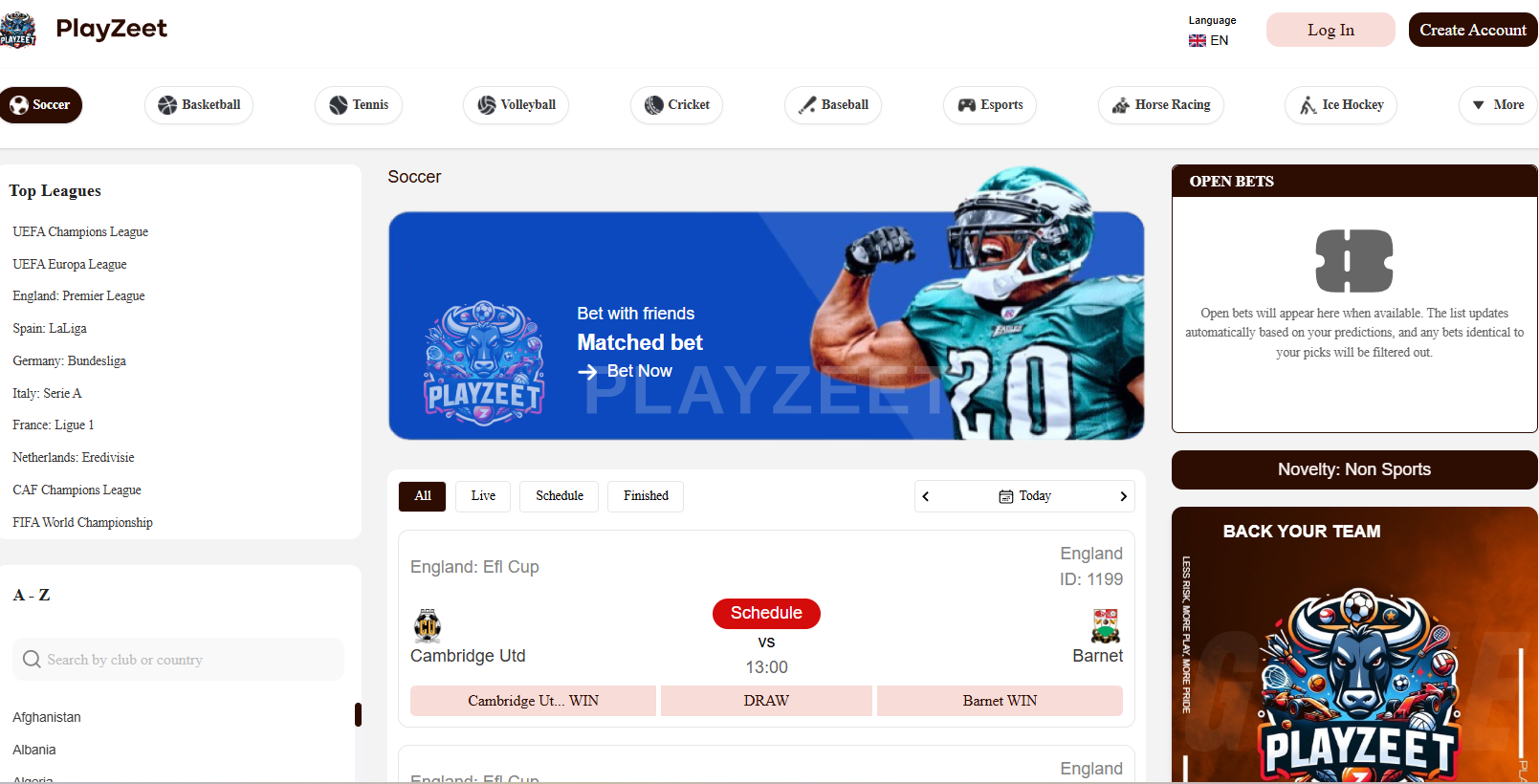
PlayZeet does not offer spread betting on cricket, and it does not use odds either. There is no buy price, no sell price, and no scaling liability tied to how far a result moves.
Instead, you and another real cricket fan agree a single fixed stake on opposing predictions, PlayZeet holds both amounts securely in escrow, confirms the official result, and pays the winner automatically.
Your maximum possible loss is exactly the stake you agreed to at the start, every single time, with nothing left to calculate afterward. Why serious bettors prefer exchanges goes deeper into the structural case for stake-based platforms over both fixed odds and spread models.
This matters most in exactly the scenario that makes spread betting dangerous: a team collapse or a sudden batting surge.
If you stake 5,000 naira on India winning the first Test against Sri Lanka at Galle, starting 15 August 2026, your maximum loss is that 5,000 naira, full stop, regardless of how dramatically the match swings before the result is confirmed.
There is no version of that stake where a wild session of cricket multiplies your liability beyond what you agreed to risk, and no version where winning consistently gets your account quietly capped either. warning signs of sportsbook restriction are worth reading if you have ever had a position closed elsewhere without explanation, and one user's real account suspension story here shows exactly what that looks like in practice.
What Is Backing and Laying in Cricket Betting?
Backing works exactly the way most bettors already understand it. You select an outcome, such as Pakistan winning their opening Test against England which begins 19 August 2026, and stake an amount on it happening. Laying flips that.
If you believe Bangladesh's historic first Test tour of Australia in 23 years, starting 13 August 2026, is more likely to end in an Australian win than most other users expect, you can lay the Bangladesh win prediction directly and collect the backer's stake if Australia takes the match.
Understanding back and lay mechanics properly before you start is worth the ten minutes it takes, since PlayZeet's interface explains exactly what you are committing to before you confirm either side.
How Does Group Betting Work for a Test Match?
Cricket, more than almost any other sport, is watched in groups, whether that is a five-day Test on in the background of a family living room or a WhatsApp group arguing about a declaration decision. PlayZeet's Group Betting feature fits that culture directly.
An Open group bet on the Galle Test result is listed publicly for any user to join. An Exclusive group bet stays off the public listing entirely and can only be joined through a shared link, useful for a specific cricket fan group that wants outsiders kept out.
A Private group bet goes straight to named people you choose yourself. All three formats settle automatically once the match result is confirmed, which makes turning a Test match social with your own circle a genuinely simple thing to set up.
Can You Bet on Season-Long Cricket Storylines?
Not every interesting cricket prediction fits inside a single match. Whether India completes a series sweep against Sri Lanka, which bowler finishes as the leading wicket-taker in the current World Test Championship cycle, or whether Bangladesh's Australia tour produces their first Test win on Australian soil are all storylines that run beyond one fixture.
PlayZeet's Novelty Betting lets users request exactly this kind of market, provided the eventual result can be confirmed through a reliable, non-controversial public source such as the official ICC scorecard.
How Do You Fund Your PlayZeet Wallet Safely?
Getting started does not require uploading a government ID at sign up. PlayZeet leans on the bank verification you already completed when you opened your own bank account, and withdrawals can only go to a linked bank account whose registered name matches your PlayZeet profile exactly.
Cross the default transaction limit of 200,000 naira or 500 US dollars, and enhanced verification kicks in, requiring a government-issued ID and a recent bank statement, handled through verrif . Every stake is authorised with your own Transaction PIN, which protects your wallet the same way a card PIN protects a bank account.
For a wider view of how PlayZeet's fixed-stake model compares with other exchanges in the peer-to-peer space, ranking of leading exchange platforms breaks down how PlayZeet, ProphetX and others differ, and features that set PlayZeet apart covers the rest of the platform beyond cricket specifically.
How Do You Place a Cricket Bet on PlayZeet?
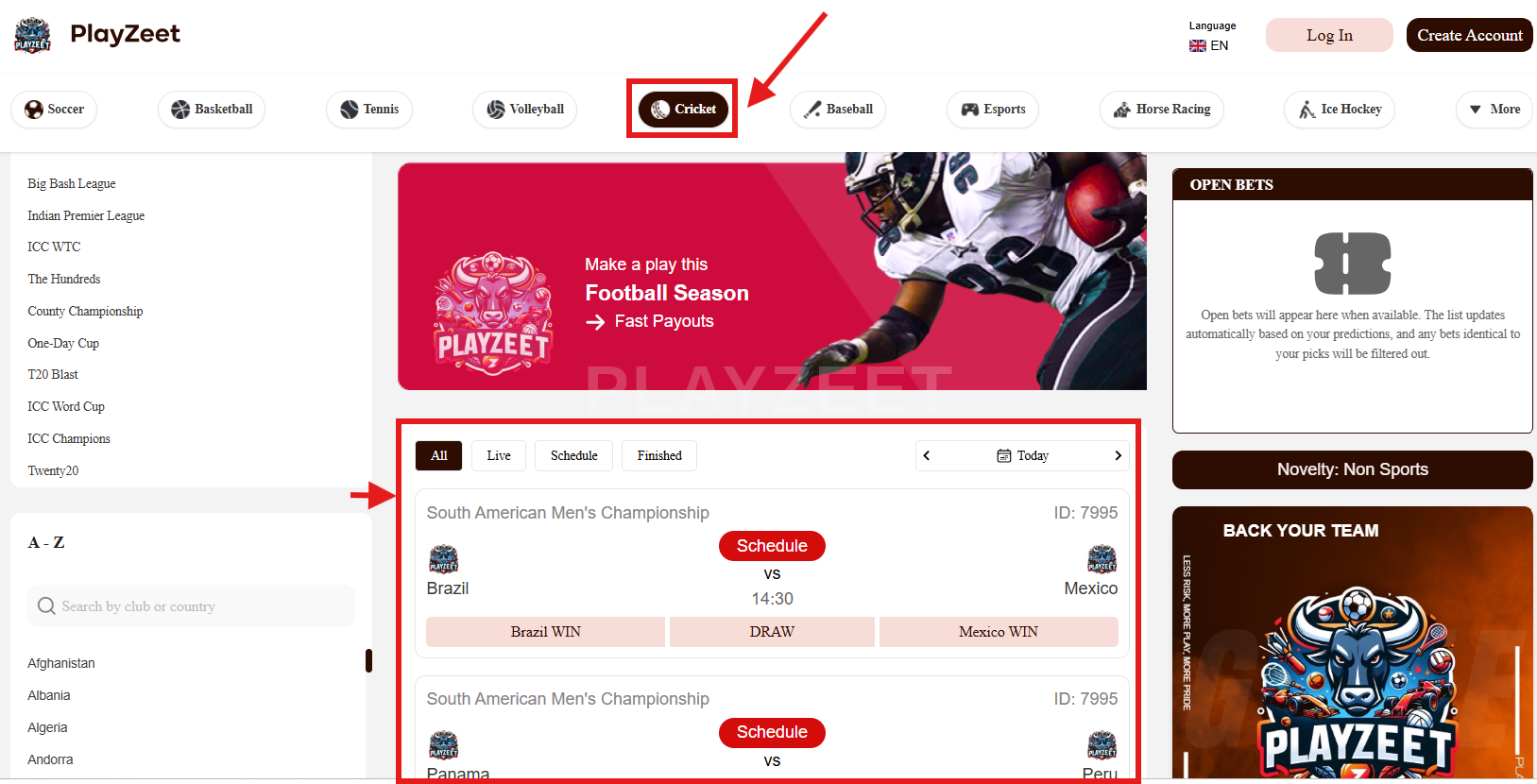
Before diving into markets, it helps to explore every bet type available on PlayZeet so you know exactly what you are choosing between at step six. Here is the full walkthrough from sign up to settlement.
Go to www.playzeet.com in your phone or desktop browser. Nothing to download, sign up takes about five minutes.
Create your account with your full name, email address and phone number, then set a password and a secret question.
Verify your email with the OTP code PlayZeet sends, then create a Transaction PIN, which authorises every stake and withdrawal going forward.
Fund your wallet through the Deposit section, starting with an amount you are genuinely comfortable treating as entertainment money.
Open the sport selector, choose Cricket, then pick the specific match or series, such as India's first Test against Sri Lanka at Galle.
Select your market: match winner, top run scorer, total match runs against a fixed number, session winner, or a head to head player duel.
Choose whether you are backing that outcome to happen or laying it to not happen, reading PlayZeet's on-screen explanation before continuing.
Enter your stake amount, confirm your wallet balance covers it, and authorise the bet with your Transaction PIN.
Track your bet's status in your bet history. It shows Pending while waiting for a match, Active once another user takes the opposite side, and Settled once the result is confirmed and PlayZeet pays out automatically.
Frequently Asked Questions
- How does cricket spread betting work?
- A firm quotes a range, called the spread, for a measurable outcome like a team's total runs. You buy above the range if you expect the real number to finish higher, or sell below it if you expect it to finish lower, and your profit or loss is calculated as your stake per point multiplied by the distance between your price and the actual final result.
- Can you bet on cricket with PlayZeet instead of spread betting?
- Yes. PlayZeet covers cricket through fixed-stake markets including match winner, top run scorer, total match runs against a set number, and session winner, all agreed directly between users with no odds and no spread involved. Your maximum possible loss is always the stake you confirm, with nothing left to calculate afterward.